Parliament Oil & Gas Hearings. This
week the leaders of industry were invited to the Commission VII hearings. These
were the top management of SKK MIgas, Pertamina EP, Pertamina ONWJ, Chevron
Indonesia, Exxon Mobil, CNOOC, ConocoPhillips, Total E & P Indonesia,
PetroChina, BOB PT BSP-Pertamina Hulu , and Vico.
The major issue
was discussion of lifting of production according to directions by Indonesian President:
target of 1 million barrels of oil per day (bpd).
- Rudi Rubiandini,
the head of SKKMigas, said that the country was likely to produce 870,000
bpd throughout next year. The most
optimistic is 900,000 bpd – in case if production of ExxonMobil at the Banyu
Urip field in the Cepu Block in East Java can start in June (land-acquisition
issues) – If not, the number is 880,000.
- Eric Isaacson, ConocoPhillips
Indonesia, President Director, confirmed discussions are going on for the next
year’s target of 29,000 bpd set by SKKMigas.
- Syamsu Alam, President
Director of Pertamina EP, stated that problems in land acquisition, licensing
for oil and gas drilling prevent from fulfilling the target: of 123 development
wells the company is currently only able to drill 64.

- One constraint
is that lawmakers are pressuring SKKMigas to push oil and gas companies to
lower the cost recovery in their business plans. SKKMigas submitted a proposal
that requested the House of Representatives to approve $17.5 billion in cost
recovery from the oil and gas sector this year. But lawmakers have been
criticizing the regulator as saying the figure is too large, and that it should
be lowered to just $15 billion.
- There is a
lack of talent to help develop the industry. “There is a brain drain in this
sector. Smart Indonesians who understand this sector … they’ve already run away
overseas. They’ve gone to Qatar, Australia, the United States or Norway”.
- Still a high
level of bureaucracy: permits and social issues that were still major stumbling
blocks. “In [West Papua’s] Tangguh project for example, there are 5,000 permits
required before it can go on-stream,” he noted

Pertamina Goals to Surpass Chevron. This
week Pertamina announced its oil production has surpassed 200,000 barrels per
day for the first time (actually, 208,157 barrels). In April it was 204,649
barrels per day; while natural gas production was 1,565 million standard cubic
feet per day. This increase was driven by PT Pertamina Hulu Energi Offshore
North West Java (PHE ONWJ) and PT Pertamina Hulu Energi West Madura Offshore
(PHE WMO) production hike. Muhamad Husen,
Pertamina Upstream Director, confirmed the ambition to overtake Chevron Pacific
Indonesia; at the same time by 2025 to be a major player in South-East Asia –
through enhancing its operations and M&A activities. One practical announcement
was made that Pertamina will start exploiting oil from Algeria in the next few
months: this would increase its reserve by 100 million barrels per day and
additional crude oil output of 23,000 barrels per day.
Komaidi
Notonegoro, Deputy Director ReforMiner, Research Institute for Mining and Energy Economics, revealed this week that oil reserves of Pertamina (609 million
barrels) are expected to be depleted within the next 8 years - on
assumption that the average oil production of Pertamina in April 2013
amounted to 204,649 bpd. For its gas reserves (7.8 trillion cubic feet),
Komaidi predicted to be finished in 14 years - on assumption of average
production of 1,565 mmscfd of gas in April. Thus, the only way out is to aggressively
conduct exploration activities on existing fields and continue to target oil
fields inside and outside country.
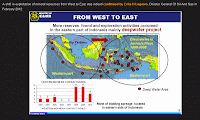
Moving to East? Eastern Indonesia (as I
mentioned in my previous Post) is one of the attractions for new developments
in Oil & Gas production. However, it is not cheap – according to Mr. Nugrahani,
Exploration Director of SKKMigas, the cost of drilling of one exploration well
is about $ 200M. It would probably take quite a while, mentioned Mr. Nugrahani,
citing the experience of Inpex in Abadi field: production is supposed to start
in 2018, while the first drilling was conducted in 1992. This is compared to development
in Western part of Indonesia where the time span is around 5 years. The GOI
(Dobernment of Indonesia) is sure that east will move on, as it was proved by Inpex
with Masela and BP with the Tangguh gas plant in West Papua. Another success was
reported this week for Lion Energy (ASX: LIO) athat is doing onshore oil
production on Seram Island, Eastern Indonesia: crude oil lifting of 300,744
barrels was completed on May 30th 2013, with Lion's share of the lifting
expected to be around US$650,000

Exploration
failures. According to the latest reports, as of May 2013, Indonesia has
168 oil and gas blocks under exploration and 21 others in the process of being
relinquished to the government. It was reported this week that 12 companies reported
$1.9 billion in losses in exploration of 25 wells for deep-sea hydrocarbon
reserves offshore Indonesia since 2009. Among these are: ExxonMobil in Surumana
and Mandar; Statoil in Karama; ConocoPhillips in Kuma, Amborip VI, and Arafura
Sea; Talisman in Sageri; Marathon in Pasang Kayu, Tately in Budong-Budong;
Japex in Buton; CNOOC in SE Palung Aru; Hess in Semai IV; Niko Resources in
Kofiau, West Papua IV, and North Makassar Strait, and Murphy Oil in Semai. As the
result, they want to return 16 exploration blocks under its management to the GOI.
Aslo 2 oil and gas deep water exploration blocks (Kumawa and Bone Bay) will be
transferred from Marathon Oil to Niko Resources.

EOR Upswing? According
to Muhamad Husen, Pertamina Upstream Director, the company could achieve an
additional 200,000 barrels per day from its enhanced oil recovery programs in
the next two years. The company is looking for partners with proven track
record in the application of EOR technologies. In 2013 the company plans to
introduce EOR technology in 18 of its oil blocks. However, this is mostly using
injection of chemicals before drilling. Meanwhile, it was announced in the
North Kalimantan city of Tarakan that the plan is under way to revive 47 oil
wells out of the more than 1,346 abandoned (since 1970-ies) wells in the area. Presently
Pertamina has only 80 wells in the city that still produce oil (output at
around 700 barrels per day and falling 20-30%).

New Indonesian Oil
Terminal. Gunvor Group and Oiltanking GmbH announced this week the plans
for construction of a greenfield terminal, Oiltanking Karimun, on the island of
Karimun (Riau Islands), Indonesia, with initial petroleum storage capacity of
760,000 cbm. This would be targeted to meet the incremental petroleum storage
needs of Greater Singapore. The terminal is expected to be operational by
second quarter 2015; will cater to the
storage and handling of both light and black oil products. The initial capacity
will be supported by four jetties capable of accommodating vessels of up to
VLCC dimensions.
Global Oilfield Rental Market - 2013 Report. It was released by Research
and Markets this week, and some interesting observations are
made there:
- Rising oil & gas prices
and increasing drilling activity will drive the global oilfield equipment
rental (oilfield rental) market to $46.8 billion by 2018.
- The factors driving growth in
the OER market are increasing drilling activity and rising oil prices. These factors are driving the production of
uneconomical field viable, tendency of drilling contractor & oilfield
service providers to rent rather than buy equipment, and advancements in
technology that hugely favors renting. Oilfield rental is a highly developing
market despite its large base due to growing energy demand.
- Oilfield rental industry is
highly fragmented and localized. Most players in this industry are very small
and have a very paltry area of influence, barring a few which are genuinely the
rental divisions of big OFS (oilfield service) provider companies. One's offering rental tools in
unconventional shale plays and ultra deep-water fields are the most successful
rental companies
These are the points that I consider the most interesting in the week
that passed. The readers are encouraged to send commentaries.


